
The demand for data-driven decision-making is growing across industries, making analytics skills increasingly valuable for students, fresh graduates, and working professionals. If you are planning to build a career in this field, you may have already searched for data analytics courses and noticed that there are both free and paid learning options available. But which one is actually better for building a successful career? The answer depends on your learning goals, budget, preferred learning style, and the level of practical experience you need.
Free resources can be an excellent starting point for beginners who want to understand the basics without making a financial commitment. Paid programs, on the other hand, can offer structured learning, instructor guidance, practical projects, certification, and career-oriented support. Understanding these differences can help you choose the right learning path instead of simply selecting a course based on its price.
What Are Data Analytics Courses and Why Are They Important?
Data analytics courses are designed to help learners understand how to collect, clean, analyze, visualize, and interpret data to generate useful business insights.
A typical analytics learning path may introduce tools and concepts such as:
- Microsoft Excel and Advanced Excel
- SQL and database concepts
- Power BI
- Data visualization
- Statistics
- Python fundamentals
- Data cleaning and preparation
- Dashboard development
- Business reporting
- Data-driven decision-making
The exact syllabus differs between providers. Some programs focus mainly on Excel and Power BI, while more advanced programs may include SQL, Python, statistics, Tableau, machine learning fundamentals, and real-world projects.
For someone targeting an analytics career, learning the software alone is not enough. You also need to understand how to interpret information, identify patterns, communicate insights, and solve practical business problems.
Free vs Paid: What Is the Difference?
The biggest difference between free and paid learning is not simply the availability of information. Today, an enormous amount of analytics content is available online for free.
The real difference is structure, guidance, accountability, practice, and career support.
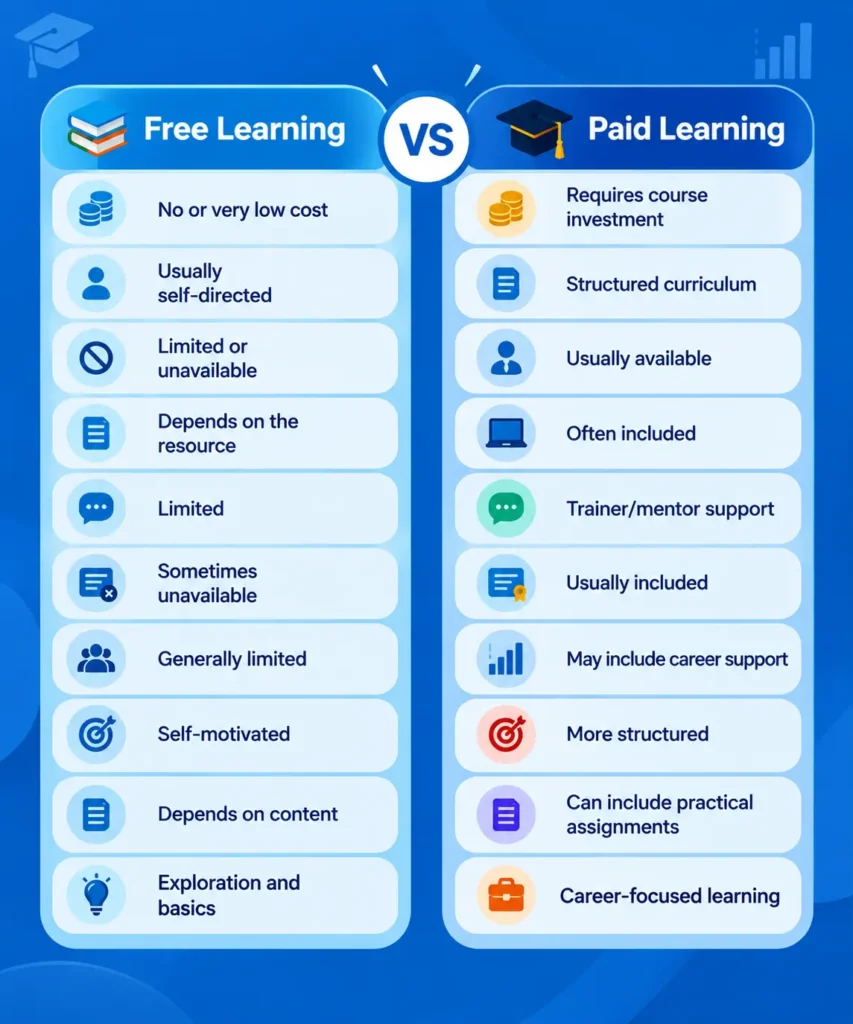
Factor | Free Learning | Paid Learning |
Cost | No or very low cost | Requires course investment |
Learning structure | Usually self-directed | Structured curriculum |
Instructor support | Limited or unavailable | Usually available |
Practical projects | Depends on the resource | Often included |
Doubt clarification | Limited | Trainer/mentor support |
Certification | Sometimes unavailable | Usually included |
Career guidance | Generally limited | May include career support |
Learning discipline | Self-motivated | More structured |
Industry exposure | Depends on content | Can include practical assignments |
Suitable for | Exploration and basics | Career-focused learning |
(The actual features of a paid course vary by institute, so learners should always check the curriculum and inclusions before enrolling.)
Advantages of Free Learning
Free learning has several important benefits, especially for beginners.
1. No Financial Commitment
The biggest advantage is obvious: you can start learning without spending money. This is useful if you are still deciding whether analytics is the right career direction for you.
2. Easy Access to Learning Materials
You can find tutorials, documentation, introductory videos, articles, practice datasets, and other educational resources online.
3. Flexible Learning Schedule
Free resources allow you to learn according to your own schedule. You can study early in the morning, after college, or after work.
4. Good for Exploring Different Tools
You can experiment with Excel, Power BI, SQL, Python, or other analytics tools before deciding which areas interest you most.
5. Useful for Continuous Learning
Even after completing a professional program, free resources can help you keep learning new features, techniques, and industry developments.
Limitations of Free Learning
Although free resources are valuable, they also have limitations when your objective is career preparation.
Lack of Structured Curriculum
You may find hundreds of videos covering the same topic but struggle to understand what you should learn first and what you should learn next.
Limited Personal Guidance
When you encounter an error while working on a project, finding the correct solution on your own can take considerable time.
Less Accountability
Self-learning requires strong discipline. It is easy to postpone lessons or stop practicing after a few weeks.
Difficulty Building Job-Ready Projects
Watching tutorials is different from creating a complete project independently. Employers generally value the ability to apply knowledge to practical problems.
Limited Career Support
Free platforms normally focus on education rather than career preparation, interview practice, resume development, or professional guidance.
Why Consider Paid Data Analytics Courses?
Paid data analytics courses can be a better option when your primary objective is to become job-ready within a structured learning environment.
A good paid program can bring together learning content, trainer support, assignments, projects, assessments, and career preparation.
1. Structured Learning Path
Instead of randomly selecting videos, you follow a planned curriculum.
For example, a structured pathway could progress from:
Excel → Data Cleaning → SQL → Power BI → Dashboard Development → Projects → Career Preparation
This approach can make learning easier to manage.
2. Trainer and Mentor Support
When you have questions, an instructor can explain concepts and help identify mistakes. This can be particularly valuable when working with SQL queries, formulas, dashboards, or data-cleaning tasks.
3. Practical Projects
Projects allow learners to move from theoretical knowledge to practical application.
For example, a learner might create:
- Sales performance dashboards
- Customer analysis reports
- Financial reports
- Marketing campaign dashboards
- Inventory analysis
- Business performance reports
These projects can also become part of a portfolio when applying for jobs.
4. Certification
A recognized course certificate can demonstrate that you have completed structured training. However, certification should not be considered a replacement for actual skills and practical experience.
5. Career-Focused Preparation
Some professional programs also include interview preparation, resume guidance, soft-skill development, portfolio building, or placement assistance.
(Always verify exactly what career support is included before enrolling.)
Which Option Is Better for a Good Career?
There is no universal answer because it depends on your current situation.
If you are simply curious about analytics, start with free resources. You can learn the basics and determine whether you enjoy working with data.
If your goal is to build a professional career, a well-designed paid program can provide a more structured path.
The ideal approach can actually be a combination of both.
Start free → Understand the basics → Choose a structured program → Build projects → Practice continuously → Prepare for interviews → Apply for jobs.
This approach allows you to use free learning for exploration while using professional training when you need deeper guidance and practical career preparation.
What Should You Check Before Choosing a Paid Course?
Don’t choose a program only because it has a low fee or a popular advertisement. Check what you will actually learn.
Look for these important factors:
Practical Curriculum
The program should include tools commonly used in analytics roles, such as Excel, SQL, Power BI, or Python, depending on your target career path.
Hands-On Training
A strong program should provide opportunities to work with datasets and create dashboards, reports, or projects.
Experienced Trainers
Trainer expertise can make a significant difference, particularly when you are learning practical concepts.
Projects and Assignments
Ask how many projects are included and whether they are based on realistic business scenarios.
Certification
Check who issues the certificate and whether it adds meaningful value to your professional profile.
Career Support
If job placement is an important factor for you, ask specifically about resume assistance, interview preparation, job referrals, internships, or placement support rather than assuming these are automatically included.
Why Consider G-TEC Education Ernakulam South?
For learners looking for a structured, career-oriented technology education option in Kochi, G-TEC Education Ernakulam South is one institute you can explore.
G-TEC’s broader education offerings include career-focused technology programs, and its Ernakulam South presence promotes skill development in areas such as Data Analytics and other technology domains.
The institute can be considered by students and professionals who prefer guided classroom learning instead of relying entirely on self-paced online resources.
Before enrolling, prospective students should review the latest course syllabus, duration, training methodology, practical components, certification details, and career-support options directly with the institute.
Explore G-TEC Education Ernakulam South:
(Course availability, syllabus, fees, schedules, and other offerings may change, so confirm the latest details directly with G-TEC.)
How Data Analytics Skills Can Support Your Career
Data is now used across many business functions, including marketing, finance, sales, operations, healthcare, retail, and technology.
Depending on your skills and experience, analytics knowledge can support career paths such as:
- Data Analyst
- Business Analyst
- MIS Executive
- Reporting Analyst
- Business Intelligence Executive
- Marketing Analyst
- Operations Analyst
A successful analytics career requires more than completing a course. You need continuous practice, problem-solving ability, communication skills, and the ability to turn raw information into meaningful insights.
For example, knowing Power BI is useful, but understanding what dashboard to create, which KPIs matter, how to interpret the data, and how to communicate the findings is even more valuable.
Free or Paid: Which One Should You Choose?
The answer becomes simpler when you consider your objective.
Choose free learning if:
- You are completely new to analytics.
- You want to explore the field.
- You have a limited budget.
- You are comfortable learning independently.
- You already have some experience and need to learn a specific tool.
Consider paid learning if:
- You want a structured curriculum.
- You need trainer support.
- You want practical assignments and projects.
- You prefer classroom or guided learning.
- You want certification.
- You need career-oriented preparation.
Ultimately, the best data analytics courses are not necessarily the cheapest or most expensive. The right choice is the program that gives you relevant skills, practical experience, guidance, and a clear path toward your career goal.
Final Thoughts
Free and paid learning options both have a place in today’s education landscape. Free resources are excellent for exploring analytics and developing foundational knowledge, while a well-structured paid program can provide the guidance, accountability, practical exposure, and career preparation that many learners need.
If you are serious about building a career in analytics, don’t judge a course only by its price. Look at the curriculum, practical training, projects, trainer support, certification, and career assistance.
Most importantly, remember that completing a course is only the beginning. Keep practicing, build a portfolio, work with real datasets, improve your communication skills, and stay updated with industry tools.
With the right combination of structured learning and continuous self-practice, you can build a strong foundation for a career in the growing field of data analytics.
Free resources can help you build foundational knowledge, but getting job-ready usually requires practical experience, projects, and a strong understanding of relevant tools. A structured program can be useful if you need guidance and a clear learning path.
Beginners can start with free resources to understand the basics. If they decide to pursue analytics as a career, moving to a structured professional program can provide additional guidance, practical projects, and career preparation.
No. A certificate can support your profile, but employers also look for practical skills. Building projects, learning relevant tools, understanding business problems, and being able to explain your analytical work are important for career growth.