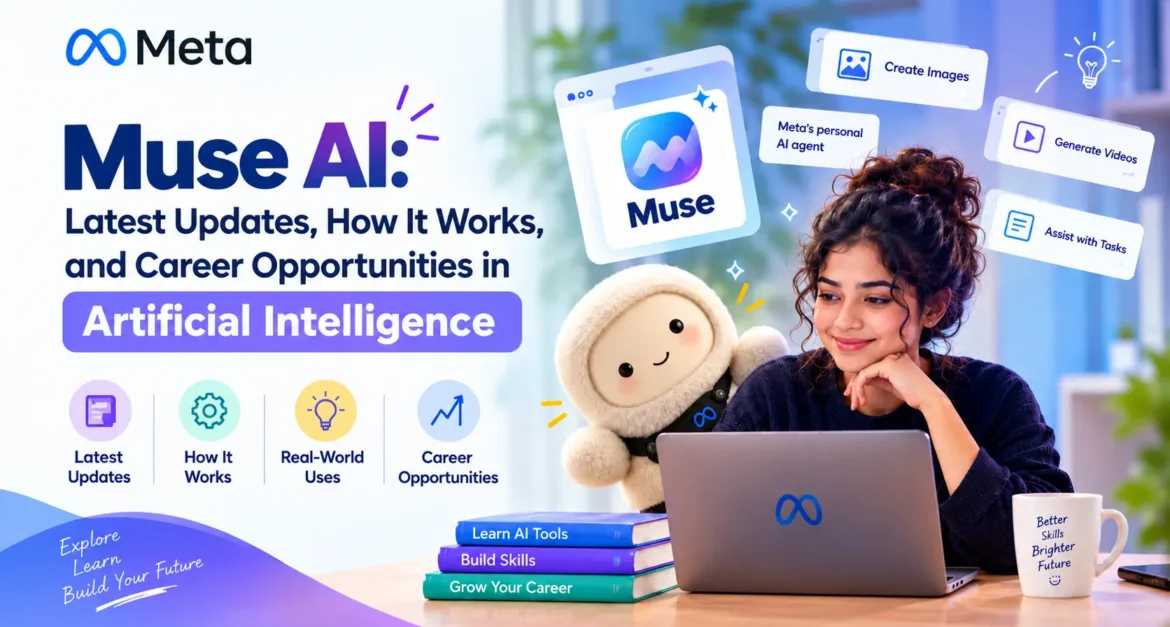
Artificial intelligence is changing the way we work, learn, and create content. From generating images to helping people complete everyday tasks, AI tools are becoming an important part of modern life. One of the developments attracting attention in 2026 is Muse AI, Meta’s growing family of artificial intelligence technologies.
Muse AI represents a shift from tools that simply answer questions to systems designed to help people complete tasks. Depending on the product, AI can assist with research, content creation, image editing, and other digital activities.
These developments are especially relevant for students, fresh graduates, job seekers, and working professionals who want to understand how AI may influence their future careers. Learning how to use AI alongside practical professional skills can help people adapt to changing workplace requirements. For anyone exploring an artificial intelligence training institute, understanding these developments is a useful starting point.
What Is Muse AI?
Muse AI is a name associated with several Meta AI technologies, rather than just one product. These technologies serve different purposes, from powering intelligent assistants to generating images and supporting creative work.
Here are the main technologies to understand.
Muse AI personal agent: Meta introduced Muse as a personal AI assistant designed to help users carry out tasks through apps and websites. Instead of simply giving an answer, an agent can work through a request and help complete multiple steps, depending on the tools and permissions available.
Muse Spark: This is a language model developed by Meta Superintelligence Labs. It serves as the underlying technology for parts of Meta’s AI experience. Think of the model as the system that processes information, while an AI agent uses that intelligence to help carry out tasks.
Muse Image: This technology focuses on image generation and editing. It can interpret written instructions and use visual references to help create or modify images.
Muse Video: Meta has also announced video-related AI technology designed to support video creation. The availability and capabilities of specific features may vary.
Although these technologies share the Muse name, they do not all perform the same function. Understanding the differences makes it easier to see how AI is developing across different areas.
Latest Muse AI Updates and Features
Meta’s Muse developments throughout 2026 have highlighted the company’s growing focus on AI assistants and creative tools.
Muse Spark and the Development of AI Models
In April 2026, Meta introduced Muse Spark, a model designed to power its newer AI experiences. It represented an important development in Meta’s AI strategy, with a focus on building more capable systems for everyday users.
Language models can process instructions, understand context, generate responses, and assist with tasks such as writing and coding. Their usefulness depends on the quality of the model, the information available, and the way they are integrated into applications.
Muse Image and AI-Powered Creativity
Muse Image brought more attention to AI-assisted visual creation. Rather than starting every design from scratch, users can describe what they want and use AI to explore different visual ideas.
For example, a digital marketer could experiment with campaign concepts, while a designer might use AI to develop an initial visual or modify an existing image. The final output still needs human review to ensure that it matches the brand, purpose, and audience.
AI-generated visuals can save time during the early stages of creative work, but they may also require corrections. Details, text, proportions, and visual consistency should always be checked.
Muse as a Personal AI Agent
In September 2026, Meta introduced Muse as a personal AI agent designed to help users work across supported applications and websites.
This type of assistant goes beyond a traditional chatbot. Depending on its available features and permissions, it may help organize tasks, gather information, prepare drafts, or carry out actions through connected tools.
Meta has also announced plans to expand Muse-related experiences, including support for its AI glasses and additional connections with other services. Announced features should not automatically be treated as available products. Availability can depend on the country, device, account, and release schedule.
Before relying on a particular feature, check Meta’s official announcements for the latest information.
How Does Muse AI Work?
The process behind an AI assistant is easier to understand through an example.
Imagine you need to research a topic, organize the information, and prepare an email. An AI assistant may help you work through the request in several stages.
- You provide an instruction.
You describe what you want in everyday language. For example, you might ask an assistant to compare a few travel options or prepare a first draft of a professional email.
- The AI interprets your request.
The system processes the instruction and identifies the different steps needed to respond. A complex request may involve gathering information, comparing options, and preparing a result.
- It uses available tools.
If the necessary integrations are supported and you have granted permission, an AI agent may interact with connected applications or websites to help complete the task.
- It prepares the result.
The output might be a summary, a draft, a list of options, an edited image, or another result related to your instruction.
- You review the output.
This step is essential. AI can misunderstand a request, make mistakes, or produce information that sounds convincing but is incorrect. Review the result before using it, especially when it involves money, professional communication, or important decisions.
Privacy is equally important. If an AI assistant can access personal or business applications, check its permissions and understand how your information is handled. Avoid sharing confidential information unless you are comfortable with the relevant privacy arrangements.
How Can Muse AI Be Used in Different Industries?
AI is becoming useful across a wide range of professions. While the specific capabilities of Muse vary by product, the broader development of AI offers several practical possibilities.
Digital Marketing
Digital marketers can use AI tools to brainstorm campaign ideas, prepare caption drafts, organize content calendars, and explore creative concepts.
For example, a marketer promoting a new course could use AI to develop several headline ideas and draft social media captions. The marketer must still decide which message suits the audience, follows the brand guidelines, and supports the campaign objective.
Graphic Designing
AI image tools can help designers explore concepts, generate visual references, and make certain editing tasks faster.
However, good design involves much more than creating an image. Layout, typography, colour selection, visual hierarchy, and brand consistency require human judgement.
Video Editing
AI tools can support video production by helping with scripts, captions, storyboards, and some editing tasks. These features can be useful for social media creators and marketing teams.
Editors still need to understand storytelling, pacing, sound, transitions, and audience engagement to create effective videos.
Software Development
AI assistants can help developers understand code, explore solutions, identify possible errors, and complete routine programming tasks.
However, generated code must be tested carefully. Developers remain responsible for software quality, security, performance, and maintenance.
Accounting and Data Analysis
AI can help organize information, summarize reports, and identify patterns in datasets. When combined with accounting software and spreadsheet skills, it may support more efficient reporting and analysis.
Financial figures and important business decisions still require verification. Accuracy, confidentiality, and professional judgement remain essential.
Education and Research
Students can use AI tools to organize study notes, understand difficult concepts, and prepare initial research outlines. These tools can make learning more convenient when used responsibly.
AI should support learning rather than replace it. Students need to check facts, understand the subject, and develop their own problem-solving abilities.
Across all these industries, one principle remains the same: AI can assist with repetitive or time-consuming tasks, but people still bring creativity, experience, critical thinking, and accountability.
Why Are AI Skills Important for Students and Job Seekers?
As workplaces adopt new technologies, employers increasingly value people who can learn digital tools and apply them to practical problems. This does not mean every student needs to become an AI engineer.
A digital marketer who understands AI-assisted content creation, an accountant who can work confidently with spreadsheets, or a developer who knows how to evaluate AI-generated code can build a stronger professional skill set.
The best approach is to combine two areas of learning:
- Practical skills: Develop a strong foundation in accounting, programming, digital marketing, graphic design, or data analysis.
- AI awareness: Learn how AI tools work, where they can help, what their limitations are, and how to verify their results.
This combination is useful for fresh graduates, working professionals, career changers, and people preparing for their first job.
Choosing an artificial intelligence training institute can help learners follow a structured path, practise relevant tools, and connect their learning with a specific career goal. The right choice depends on the learner’s background, interests, and the quality of the training offered.
How to Choose the Right AI Training Institute
Before selecting a course, take time to understand what you want to achieve. A student interested in digital marketing may need a different learning path from someone who wants to become a software developer.
Here are a few important points to consider.
- Practical training: Look for opportunities to work on exercises and projects rather than relying only on theory.
- Relevant tools: Check whether the course covers tools and software related to your chosen field.
- Experienced trainers: Ask about the trainers’ professional experience and teaching approach.
- Project work: Practical projects can help you demonstrate your skills to potential employers.
- Suitable course level: Choose a course that matches your existing knowledge and career goals.
- Updated syllabus: AI technology changes quickly, so learning materials should be reviewed regularly.
- Career guidance: Resume preparation, interview practice, and career advice can be valuable additions.
A good course should help you understand the subject and apply what you learn. Certificates can be useful, but practical knowledge and the ability to demonstrate your skills matter too.
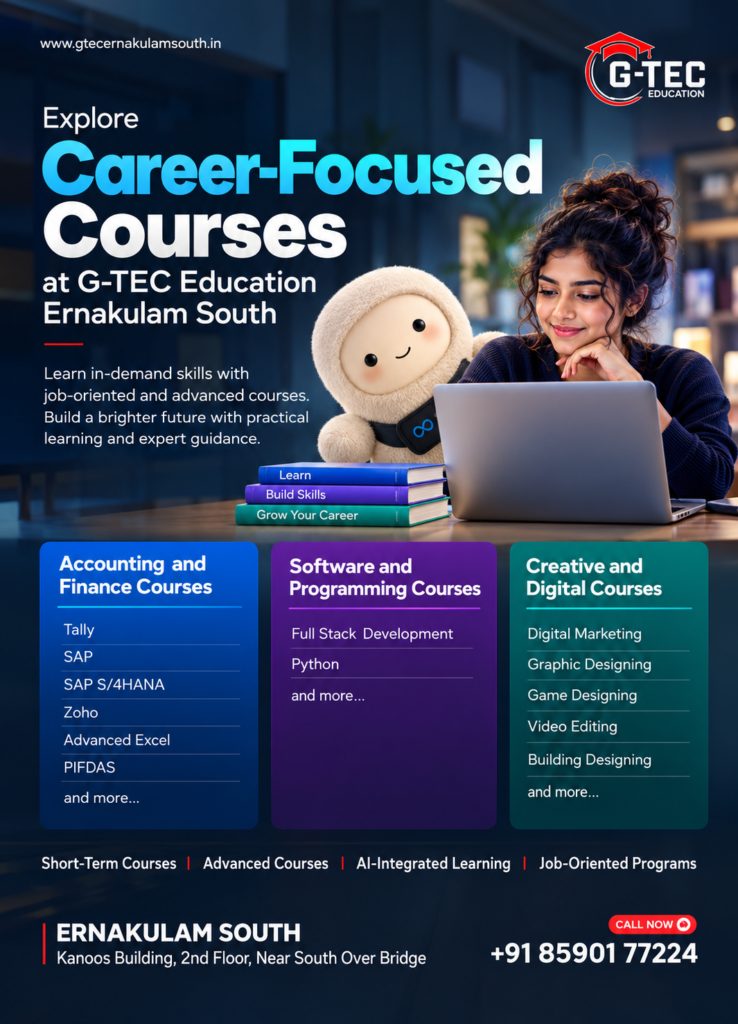
Explore Career-Focused Courses at G-TEC Education Ernakulam South
For students and professionals looking to develop practical skills, G-TEC Education Ernakulam South offers courses across accounting, software development, digital technology, and creative fields.
The institute provides different course options, including short-duration job-oriented programs and advanced courses. The availability and scope of AI-integrated learning may differ by program, so students should confirm the latest details directly with the institute.
Accounting and Finance Courses
Accounting and finance learners can explore courses and software training related to:
- Tally
- SAP
- SAP S/4HANA
- Zoho
- Advanced Excel
- Other accounting and finance programs
These skills can be useful for people interested in accounting, financial reporting, office administration, and business operations.
Software and Programming Courses
Students interested in technology can explore options such as:
- Full Stack Development
- Python
- Other software development courses
These areas can help learners build a foundation in programming, web development, and software-related work.
Creative and Digital Courses
For those interested in creative careers and online business, available course categories include:
- Digital Marketing
- Graphic Designing
- Game Designing
- Video Editing
- Building Designing
- Other creative and technical programs
These subjects offer different learning paths for people interested in digital campaigns, visual communication, media production, and design.
Having several course categories in one place can make it easier to compare options. For example, someone interested in both digital marketing and graphic design can explore how the skills differ before choosing a suitable program.
If you are looking for an artificial intelligence training institute or a practical course to support your career development, consider your interests first. Contact G-TEC Education Ernakulam South to confirm current course availability, duration, fees, syllabus, certifications, and whether a particular program includes AI-integrated training.
Muse AI reflects a wider change in how artificial intelligence is being developed and used. From language models and personal assistants to image-generation and video technologies, AI is creating new ways to approach everyday tasks and professional work.
At the same time, technology alone is not enough. People need practical skills, the ability to evaluate AI-generated results, and the judgement to use these tools responsibly.
For students and job seekers, now is a good time to explore a field that matches their interests and build skills step by step. A suitable artificial intelligence training institute can provide structure, practical learning, and guidance as you prepare for changing career requirements.
If you are exploring courses in Kochi, G-TEC Education Ernakulam South offers several learning options across accounting, software development, digital marketing, and creative fields. Review the available programs, identify your career goals, and contact the institute to find a course that fits your plans.
The goal is not simply to learn the latest AI tool. It is to build skills that remain useful as technology continues to evolve.
Muse AI refers to Meta’s AI technologies, including its personal AI agent and creative tools for generating images and videos. Depending on the product, these technologies can help users complete tasks, create content, and improve productivity.
As of October 2026, Meta Muse is not officially available in India, according to current availability reports. Access may vary depending on the specific Muse product, device, and rollout schedule. For the latest updates, check Meta’s official website and announcements before attempting to access the service.
G-TEC Education Ernakulam South offers courses across areas such as accounting, software development, digital marketing, and creative design. Contact the institute to confirm current course availability, duration, and the specific skills covered in each program.